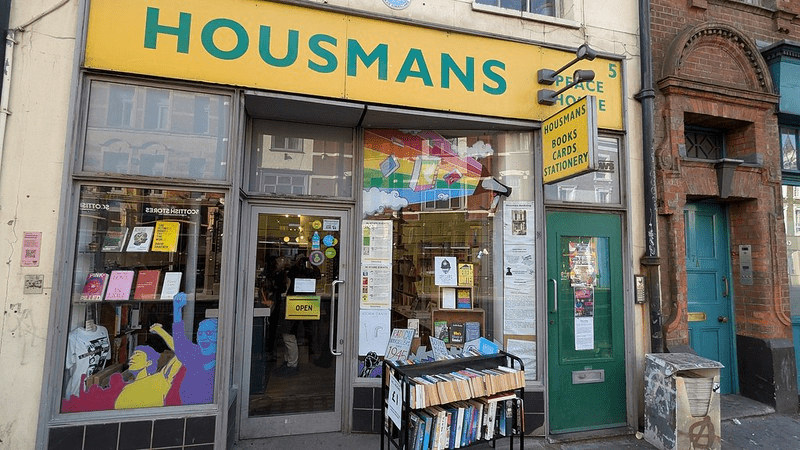
Housmans Bookshop is considered the oldest continuously active radical bookshop in Great Britain. Established in the post-war period, from its earliest days it served as a platform for distributing literature that condemned war, violence, and militarism. In this way, the shop became a central intellectual and cultural hub for activists, researchers, and artists. Read more at londonski.
The Founding and Development of Housmans Bookshop
In 1936, the Peace Pledge Union (PPU) opened a temporary bookshop at 36 Ludgate Hill in London. This modest space became a centre of intellectual and moral resistance to militarism, where people would gather on the floor to listen to lunchtime lectures by the prominent clergyman and pacifist campaigner Dick Sheppard. Even then, the establishment functioned not just as a retail outlet, but as a place for meetings and discussions. However, its activities were limited due to the lack of a shopfront, with books sold mostly by mail order.
The turning point came in 1945. After the Second World War, the idea of creating a permanent bookshop dedicated to the ideals of peace was born among its enthusiasts. The initiative came from the writer and playwright Laurence Housman, a long-time supporter of the PPU. He envisioned the shop not only as a tool for promoting pacifism but also as a space to support the ideas of human rights and a just economy. Thanks to their collective efforts, Housmans Bookshop opened in 1945. It thus began to spread humanist ideals at a time when British society was in a state of moral renewal.
The further development of Housmans Bookshop was made possible by the generosity of supporters like Tom Willis. With his donation of £5,000, the team managed to purchase a derelict building at 5 Caledonian Road in 1958. After its renovation, the offices of Peace News moved to the upper floors, and the shop reopened as a fully-fledged bookshop. The grand opening was attended by key figures of the British pacifist movement, including Vera Brittain, Myrtle Solomon, and Sybil Morrison.
The emergence of a powerful nuclear disarmament movement in Great Britain in the late 1950s and early 1960s provided a major boost to Housmans’ influence. During these years, its shelves were filled with pamphlets and literature related to the Campaign for Nuclear Disarmament and the Committee of 100. These organisations were known for their active peacemaking stance, and the presence of their materials in the shop’s stock reinforced its role as an information hub.
In the 1970s and 1980s, Housmans Bookshop became a unique space where one could find gay and lesbian literature. This was possible thanks to its namesake, Laurence Housman, who was an openly gay man and an active supporter of the LGBT+ liberation movement. With limited access to such literature in Britain, a significant portion of the publications was imported from the United States. The bookshop also became part of a broader resistance campaign against repression, raids, and censorship.
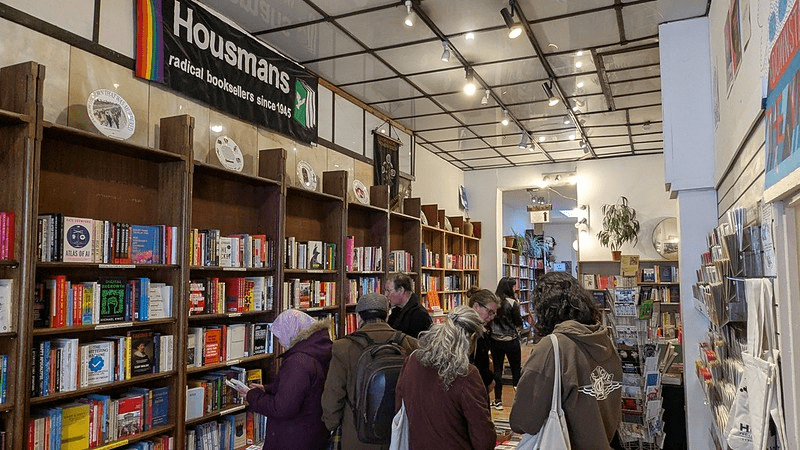
The subsequent transformations of Housmans Bookshop demonstrated its ability to adapt to new challenges and societal demands. In 2016, a major expansion was undertaken with the opening of a basement space named ‘The Vaults’. It became a home for fiction, poetry, graphic novels, art, and children’s books. Additionally, the sections on the main floor were significantly expanded to cover anti-racism, disability politics, health policy, and Irish history. This renovation coincided with the bookshop’s 70th anniversary and symbolised the continuation of its mission.
The Legacy and Significance of Housmans Bookshop
For 80 years, Housmans Bookshop has consistently pursued its mission of promoting peace, human rights, and the ideals of social justice. Its unique role lies in its steadfast resistance to war, violence, inequality, and discrimination, using the book as a tool for thought, resistance, and unity. The shop has brought its patrons together in literary groups such as the Housmans’ Feminist Sci-Fi Book Club, the Housmans’ Queer Book Club, and the Fuse Book Club. Furthermore, it organises events featuring well-known intellectuals and activists, including Naomi Klein, Emma Dabiri, and John Sinclair. Thus, the establishment remains a symbol of civic resistance and a culture of independent thought.