

Maggie Albanesi, a theatre and film actress, played an important role in the development of British stage life at the beginning of the 20th century. She was a contemporary of such drama legends as Sybil Thorndike, Noël Coward and John Gielgud. However, the actress’s life was cut short before the theatre world fully recognised her talent. Learn more at londonski.
Maggie Albanesi’s early years and acting career
Maggie Albanesi was born in London on October 8, 1899. The girl grew up in the family of writer Effie Adelaide Rowlands and musician Carlo Albanesi. Having inspired a love for art in their daughter, her parents accepted Maggie’s desire to build a theatrical career. Later, they supported her entry into the Royal Academy of Dramatic Art. The young actress studied under the guidance of the American actress Helen Hayes, who was known as the First Lady of American Theatre. Her student was awarded the Bancroft Medal for academic achievements.
Maggie Albanesi began her professional career as a stunt double in the production of James Matthew Barrie’s play Dear Brutus. Later, her independent debut happened in Alexander Butler’s British silent comedy A Pair of Spectacles. The young actress also demonstrated her skills in Matheson Lang’s film Mr. Wu in 1919. As a result, critics publicly recognised her achievements, which had bright prospects for further development in the British theatrical world.
In 1920, John Galsworthy’s play The Skin Game was first staged at London’s St. Martin’s Theatre and Maggie Albanesi played the leading role there. 1921 was the year of the triumphant premiere of Clemence Dane’s most famous play A Bill of Divorcement. The role in that play allowed the actress to take her place among the most iconic figures of the new stage generation.
After co-starring in John Galsworthy’s play The First and the Last, Maggie Albanesi began a relationship with her colleague Owen Nares. Although the man was already married to the actress Marie Pollini, he succumbed to a new passion. However, the actor left the extramarital affair when his wife found out about it. From that moment, Maggie’s professional and personal life plunged into chaos.
Trying to cope with the pain, Maggie Albanesi was repeatedly involved in romantic and sexual intrigues. In particular, she was close to the theatre and film director Basil Herbert Dean. The actress’s dissolute life led to several abortions, which worsened her health. Having undergone several operations, she recovered in a nursing home. As a result of an illegal abortion, the woman was again forced to face abdominal surgery due to a ruptured intestine. Despite the efforts of doctors, she passed away on December 9, 1923. It was believed that Basil Herbert Dean was so obsessed with Maggie Albanesi that he married her copy, actress Victoria Hopper.
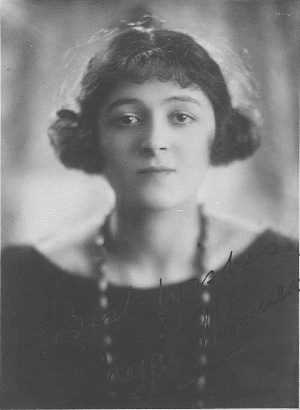
Wikipedia
Significance and recognition of Maggie Albanesi’s activity
Despite her short-lived career, Maggie Albanesi has remained a cult figure in the British stage world. She became a star of the St. Martin’s Theatre, the Grand Theatre, His Majesty’s Theatre and the Ambassadors Theatre, in particular, thanks to her participation in such plays as East of Suez, The Lilies of the Field, Loyalties, etc. At the same time, her popularity in cinema is associated with such films as The Romance of Old Bill, Darby and Joan, The Great Day and others. Maggie Albanesi was honoured with a memorial plaque by sculptor Eric Gill in the foyer of the St. Martin’s Theatre.
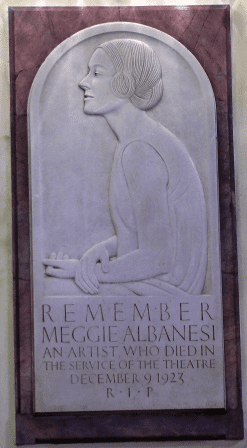
London Walking Tours