

The Sensation exhibition did more than just showcase art; it ignited a fierce national debate over the professional boundaries of the artist. By fusing high art with mass culture, it confronted the public with raw, unfiltered creative expression. Ultimately, the event cemented the Young British Artists (YBA) movement as a pivotal force in the contemporary creative world. More on londonski.
The Origins and Evolution of Sensation
Art dealer Charles Saatchi’s fascination with Britart began after he attended the Freeze exhibition in 1988. He soon became the first major collector of Damien Hirst, a leading figure among the Young British Artists. By 1992, Saatchi began organising the Young British Artists exhibition series, which became a launchpad for the movement’s rising stars.
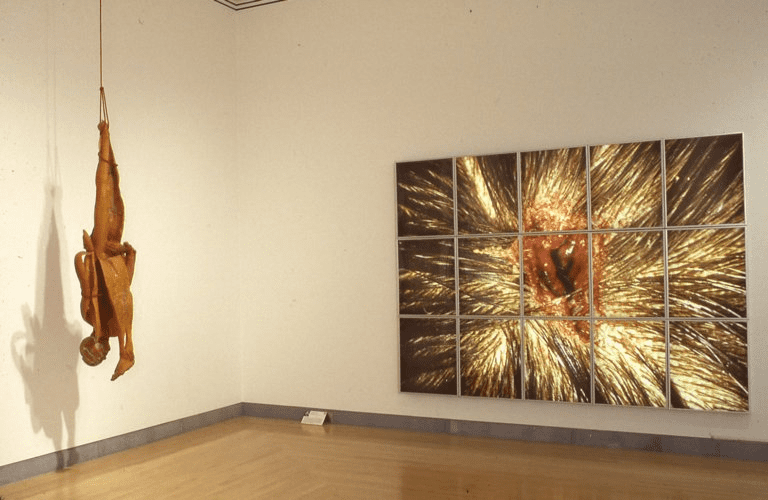
The movement reached its zenith in 1997 with the Sensation exhibition at the Royal Academy of Arts. Drawing nearly 300,000 visitors, the show sparked widespread protests and dominated the headlines. The exhibition featured 110 works by 44 different artists from Saatchi’s private collection. Tackling themes of death, sexuality, and violence, its provocative nature caused a media frenzy. One particular lightning rod for public outrage was Jake and Dinos Chapman’s installation featuring anatomically distorted mannequins, where noses were replaced with male genitalia and mouths resembled anuses.
The controversy deepened with Marcus Harvey’s portrait of serial killer Myra Hindley. Composed of hundreds of child-sized handprints, the work drove the protest group Mothers Against Murder and Aggression to action. Activists attacked the painting twice, pelting it with ink and eggs. Even Hindley herself wrote from prison, requesting the work be removed out of respect for the victims’ families. However, David Gordon, Secretary of the Royal Academy, stood firm, arguing that Hindley’s image had become a matter of public record that demanded discussion rather than silence. Consequently, this harrowing reflection of recent British history remained on display.
In 1998, Sensation moved to Berlin’s Hamburger Bahnhof, where German audiences perceived the YBAs’ work as somber and earnest rather than cynical or witty. By 1999, the exhibition reached the Brooklyn Museum in New York, where Chris Ofili’s The Holy Virgin Mary became the new centre of the storm. The painting, a Black Madonna adorned with elephant dung and collaged images of female genitalia, led to the museum briefly losing its funding. Although the budget was restored following a petition from prominent actors, writers, and artists, public anger persisted. One visitor even smeared white paint over the canvas; he was arrested, and the painting was subsequently placed behind a Perspex screen.
Wikipedia
Legacy and Impact of Sensation
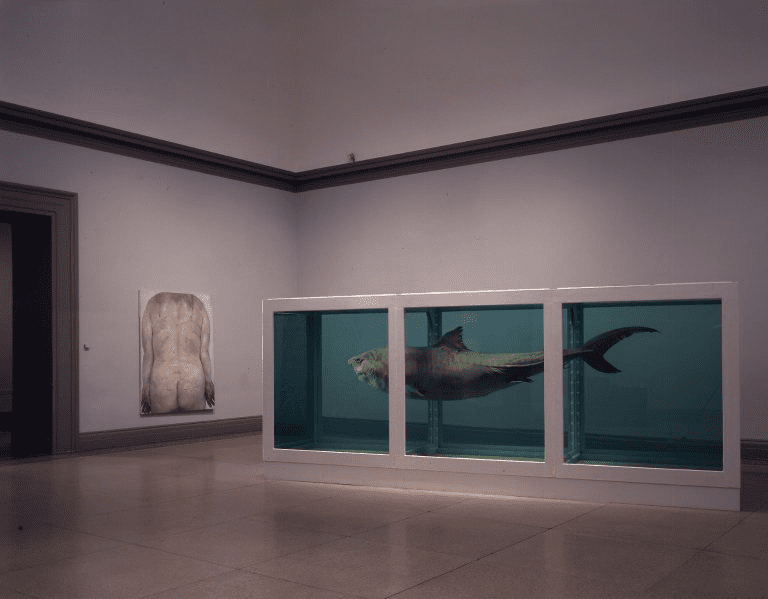
By leaning into taboo subjects, Sensation challenged traditional notions of creativity and helped internationalise British contemporary art, influencing provocative movements worldwide. The event also highlighted the immense power of private collectors. Iconic pieces such as Tracey Emin’s tent, Everyone I Have Ever Slept With, Damien Hirst’s shark in formaldehyde, The Physical Impossibility of Death in the Mind of Someone Living, and Marc Quinn’s self-portrait, Self, remain etched in the public consciousness.
Wikipedia Would you like me to translate any other art-related articles into British English?