

When one thinks of art and creativity, European countries like Italy, Spain, or France usually come to mind. Great Britain and rainy London often evoke nostalgia and deep thought, but they are less frequently seen as sources of artistic masterpieces. However, the city can boast a large number of world-famous painters, poets, architects, and musicians. One only needs to recall the unique works of Bridget Riley or the incredible photos created by Cecil Beaton. Yet, brilliant artists in London were dazzling the world even in the 19th century. Dante Gabriel Rossetti belongs to this period. It wasn’t just his name that was aesthetic and graceful, but nearly his entire life, and especially his creative works. What does his story hide, and what makes his art so distinct? Read on at londonski.
Origins, Childhood, and the Beginning of His Creative Path
Dante Gabriel Rossetti was born on May 12, 1828, in London. He was homeschooled as a child but later enrolled in King’s College School, where he became fascinated with the works of prominent British writers. This marked the beginning of his creative journey as a poet. However, the world would later discover that Dante had a gift for painting, as it was his pictures that would make him famous. In his youth, Dante Gabriel Rossetti was distinguished by his composure and eloquence, which were combined with a reckless and fiery character. This temperament could be explained by his heritage. His father was a scholar, and his mother was the daughter of a scholar, but both were Italian. It’s also worth noting that in this family, creativity became a characteristic trait for many. For instance, Dante’s two sisters were deeply involved in writing, and his brother was a well-known critic.
As mentioned above, Dante Gabriel Rossetti began his creative career in writing. He admired the works of medieval Italian authors, paying particular attention to translating the works of Dante Alighieri. This is also why the writer often placed his first name, Dante, at the forefront and almost always introduced himself this way (although he was called Gabriel as a child). However, a significant event that led him into the world of painting was the founding of the Pre-Raphaelite Brotherhood in 1848. It was established by Dante Gabriel Rossetti himself and two other famous artists. This was an entire movement aimed at reforming English art, characterized by a return to rich colors, detailed work, and complex compositions.
Characteristics of His Work and Influence on Artistic Trends
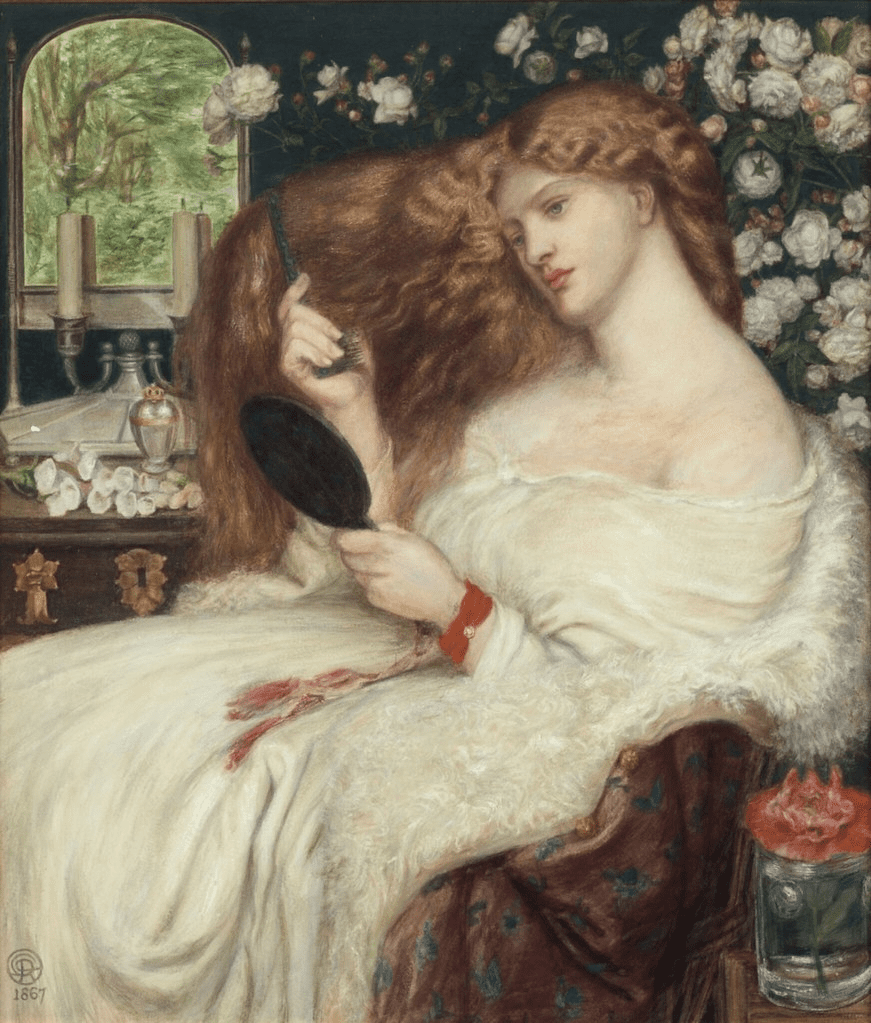
Dante’s early works fully reflected the characteristics of the early Pre-Raphaelite movement. They were painted in oils and simply amazed critics and other artists. Among the most popular paintings from this period are “Girlhood of Mary Virgin,” painted in 1849, and “Ecce Ancilla Domini,” created in 1850. Later, after facing harsher criticism, the artist returned to watercolor for a time. The next 10 years were incredibly successful. Dante Gabriel Rossetti also worked on realistic themes. For example, his work “Found” depicts the then-relevant theme of urban prostitution. However, the artist still preferred creating symbolic and metaphorical images. In the 1860s, he returned to oil paints. From that time on, he increasingly depicted women in his paintings (usually with luxurious, long, red hair). These figures became the author’s defining feature and brought him worldwide fame.
Overall, Dante’s body of work includes a vast number of pieces that vary in style, technique, and color intensity. His art influenced the European Symbolists and paved the way for the formation of the Aesthetic movement.